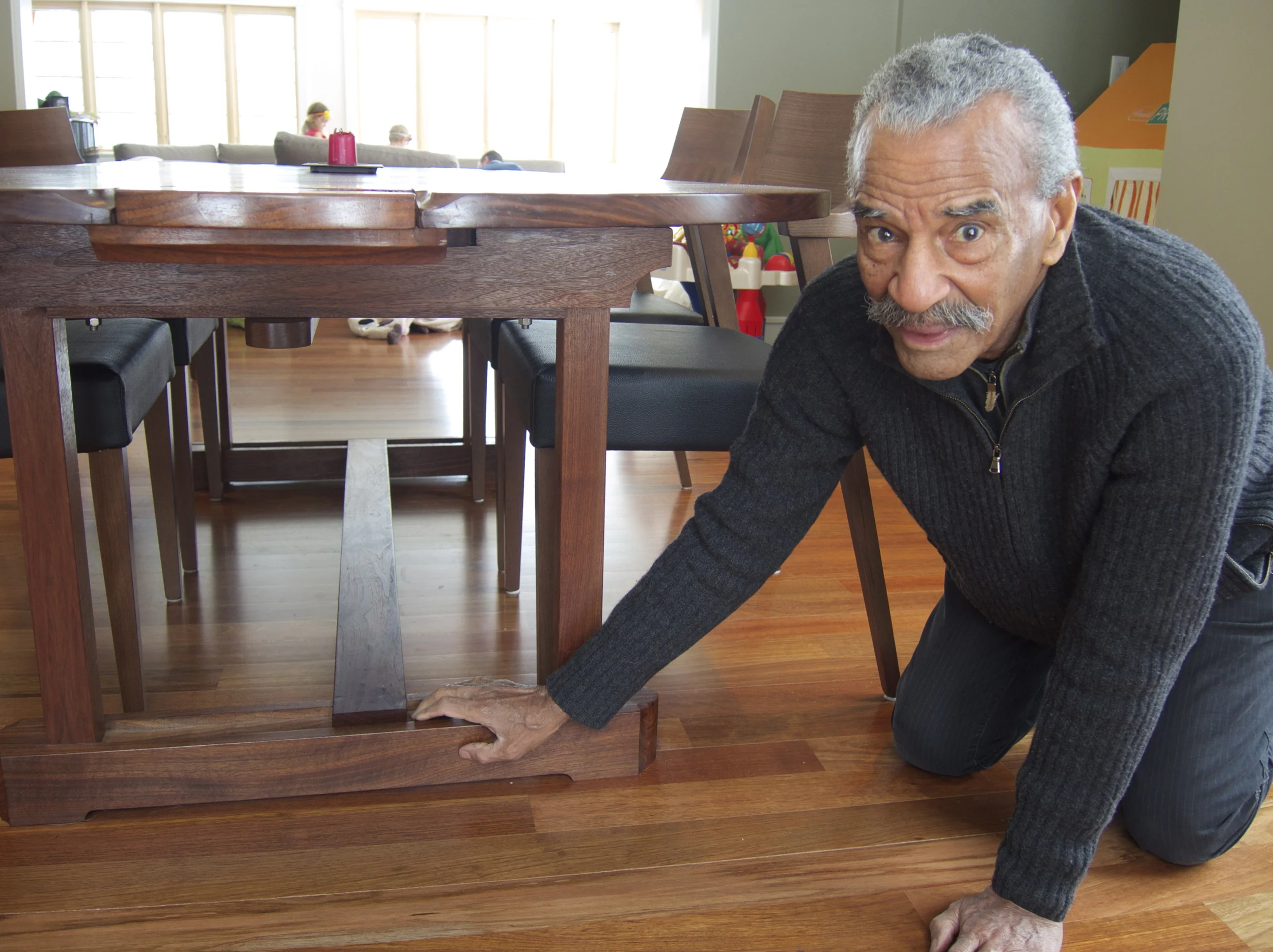
Want to turn your mind into a field of flowers? Start working with hand tools. And stop beginning a work with precisely scaled drawings. Making a one-of-a-kind chair, bed or table for a client is a challenge that cannot be solved by too much power or too much systematic planning. If you’re not working with plastic or metal, wood tends to arrest a projects development; it should always be the prime ingredient of the work at hand.
I never make the same piece twice; if I have to do it again—there are no plans—I have to go back to the imagination again. Hand sawing and hand planing turn the body into a machine, sort of like those who travel the elliptical trainer for an (expensive) hour a day. Yet, as the hand gets steadier, the close connection with the material under-hand lets the worker into his or her work, almost allowing the piece grow from inside out.
I have been making single items of furniture for fifty years—indeed, at times, with power tools; having made hundreds of dovetail drawers, raised panels (as illustrated in the back of the chair atop the home page) and maybe a thousand mortise and tenon joints. Each piece surprises me as I work; it may do so for the client: better than the bargain. I haven’t used the word creative, yet; I’m not so sure about it: more times it is accident, mistake, pulled into the work. Wood is the literal accident in furniture making; those I enjoy the most, walnut, rosewood (Brazilian) and white oak, cut to show wide surfaces of rays. Then there is cherry, Birdseye maple, teak and, last but not least—particularly to beginners—clear pine.