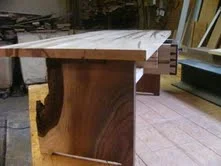
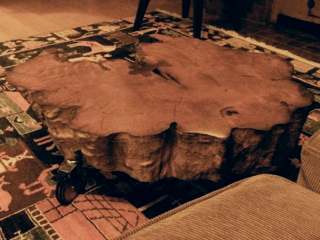
Hand tool woodworking has given us the entire catalogue of antique furniture prior to the industrial era, yet it is common to believe the chairs we sit on and the beds we rest in can only be made with machines.
This course is similar to one I taught at The New School thirty years ago: making good furniture, not in a factory or machine shop, but in a corner of one’s living space using less than a dozen tools; planes and multi-planes, saws and turning saws, hand drills, chisels, modern glues and fasteners, and of course lots of bar and c-clamps.
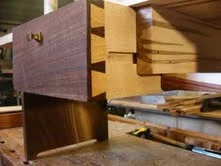
Even in our modern age, it is difficult to impossible to repair an antique with machinery without completely disassembling it. And, today, respecting fineness of work, it is not possible to tell whether a piece is made with hand tools or very expensive machinery. And artists of one-of-a-kind chairs and tables where the advantages of mass production do not obtain, are inclined to restrict their fine work to hand tools. I have never made a drawer with machinery, the signature piece in table and cabinetmaking.
In the Colonial period young boys apprenticed to tradesmen, learning carving, turning legs on a foot-actuated lathe, and completed their work-study as joyners—those who put or joined the entire piece of furniture together. Most of these boys did not go to school, no textbooks were written on the subject.
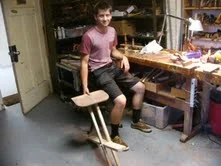
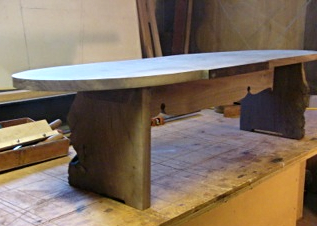
Our class is conducted in the same spirit where kids learn by doing and slowly evolve through the techniques of tool use and basic structures in furniture-making tradition. Many possibilities present themselves in the design and building of a chair. The chair is the signature piece of a furniture maker, indeed many architects have become famous for a chair. This beautiful and delicate structure that must hold the human body comfortably is represented in an almost limitless catalogue of design, both primitive and sophisticated, both stool and throne, and almost all the creation of woodworkers. Our class will start with a pine bench and evolve through draw-making, gluing up table tops, constructing frame panels for cabinet doors and mortise and tenon joinery.
Although the lumber we get at the mill represents a machine-intensive process we do not use any power tools in our work. Yet machines are not discouraged; this is a choice that may change in the student’s progress. Any way one makes furniture may become a livelihood, the variables being the art and the customer—the chair can be priced from forty dollars to four thousand.
We conduct a six week, thirty hour workshop, or a much preferred ongoing apprenticeship, where the goal is a one-person shop, capable of everything from estimating commissions for complicated pieces to buying hardwoods to paying taxes.
Parents are invited to stay for any and all classes and encouraged to participate where skills apply.
For more information please contact Richard Hardie directly at 413-270-1184.